Blockchain tracking for lab samples
A design that traces every lab sample from patient QR code to on-chain report, against pre-analytical errors.
- Private DLT
- ERC-6551
- ERC-7401
- ERC-721
- Internet Computer
- IoT transponders
- QR codes
- 46–68%of lab errors happen before analysis, per the health-authority report the design starts from
- 8steps from the patient's QR code to the on-chain report
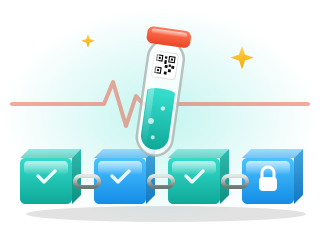
A lab sample's trip, written to a ledger
A design, not a prototype: every step of a sample, from the patient's QR code to the report, is signed and written to a permissioned ledger.
Tap a block to see what it does.
- People
- Logic
- Data
- Output
People
Patient app
Mobile DApp with two-factor login. Creates the ERC-6551 health passport, which also works as a wallet; the patient grants or refuses access to each record.
- DApp
- ERC-6551
- 2FA
Hands to Sample collection
Logic
Sample collection
The patient shows a QR code and the platform links the operator to the patient's log in real time. Reading or sharing data needs the operator's digital signature.
- QR code
- Digital signature
Gets from Patient appHands to Tube label, Private ledger
Logic
Tube label
The test request is written to the ledger and identified by a hash, printed as a QR code and stuck on the tube.
- QR code
Gets from Sample collectionHands to IoT transport
Logic
IoT transport
The tube travels in a transponder container along a roller route that records transport and storage conditions from start to end.
- IoT transponder
Gets from Tube labelHands to Lab processing, Private ledger
Logic
Lab processing
The sample is registered and checked on arrival, then processed; the result is written back on-chain.
Gets from IoT transportHands to Private ledger
Data
Private ledger
Permissioned DLT shared by operators and lab, with smart contracts that help match the diagnosis. The deck also names ICP as the chain.
- Private DLT
- Smart contracts
- ICP
Gets from Sample collection, IoT transport, Lab processingHands to Doctor's report
Output
Doctor's report
The report reaches the requesting doctor through the DApp automatically and is added to the passport as an ERC-7401 child token.
- ERC-7401
- ERC-721
Gets from Private ledger
The problem
In a clinical lab, 46–68% of errors happen before the analysis starts: patient identification, collection, labelling, transport and storage, according to a regional health-authority report. Systems that do not talk to each other and poor sample tracking make those errors hard to catch.
What I built
- Proposed a private, permissioned ledger for health operators instead of a public chain, for privacy, performance and a custom consensus.
- Designed a patient app with two-factor login that creates a digital health passport; the patient decides who can see each record.
- Modelled the record as a token hierarchy: an ERC-6551 token-bound account as the passport, holding ERC-7401 and ERC-721 children for tests, prescriptions and procedures, signed by operators.
- Mapped the physical path: the test hash printed as a QR code on the tube, and an IoT transponder container that writes transport and storage conditions to the ledger.
The hard part
Health data on a ledger has to survive a GDPR review. The design answers with a private ledger and patient consent, but it leaves gaps I would close today: hashes on-chain and data off-chain so records can be erased, a clear link between the private ledger and the ICP chain the deck also names, and a way to trust IoT readings before they are written (the oracle problem).
Result
Submitted as my individual final paper, a 16-slide deck, for a blockchain management course. The course's overall grade was B+, not broken down by paper. Concept only: no prototype was built.
My role
Individual work: research, concept, architecture and slides. No AI tools are documented for it.